
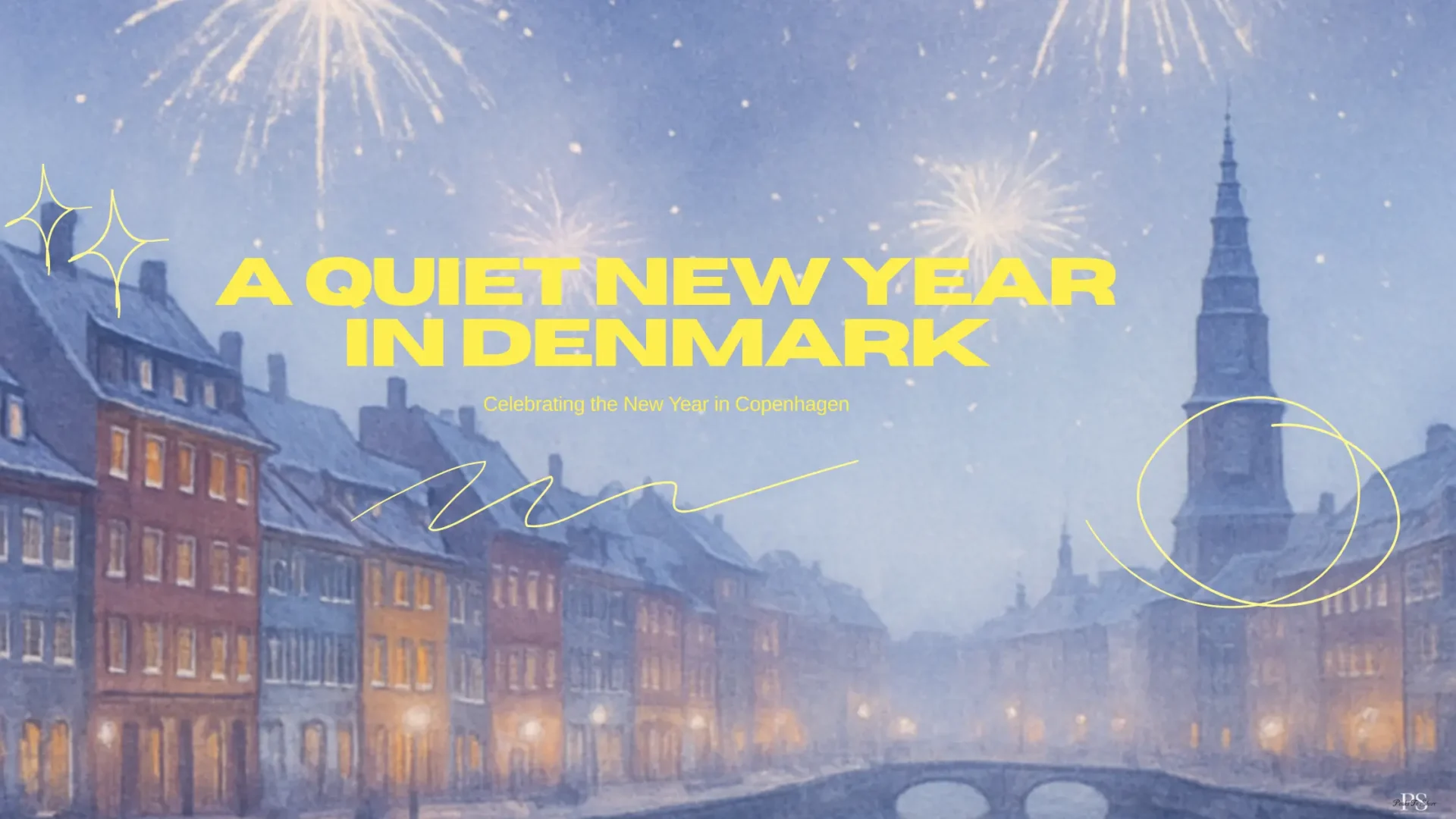
Denmark isn’t silent on New Year’s Eve — and that’s an important distinction to make.
There are fireworks. There are crowds. In Copenhagen, Rådhuspladsen (City Hall Square) becomes the city’s natural focal point as midnight approaches. People gather, bottles are opened, fireworks fill the sky, and for a short window, the city feels loud, chaotic, and alive.
But what surprised me wasn’t the presence of celebration.
It was how quickly it all disappeared.
Starting the New Year in Denmark isn’t about an endless night of partying or a dramatic reset. It’s about contrast — intensity followed by stillness, noise followed by quiet, energy followed by rest.
And that rhythm changes how the New Year feels entirely.
New Year’s Eve in Copenhagen: Controlled Chaos
If you’re in Copenhagen on December 31st, you’ll feel the shift as evening approaches.
Public transport runs late, streets in the city centre grow busier, and groups slowly move toward Rådhuspladsen, which functions as the closest thing Copenhagen has to a centralized New Year gathering. Locals, expats, and tourists all converge here, many carrying their own fireworks.
Unlike cities with highly organised countdown events, Copenhagen’s New Year feels informal and loosely structured. There’s no official stage, no single countdown, and no choreographed fireworks show.
Instead, midnight arrives in fragments — shouted countdowns in different languages, cheers breaking out at slightly different moments, and fireworks launched from every possible direction.
You can read more about the square itself on the official Visit Copenhagen site:
Fireworks Without the Polish
Fireworks are a huge part of New Year’s Eve in Denmark, and Copenhagen is no exception.
But this isn’t a polished spectacle.
The fireworks are loud, unpredictable, and constant for a short period of time. Smoke fills the air. The streets get messy quickly. Broken glass, spent fireworks, and debris are unavoidable, especially around the city centre.
It feels raw and unfiltered — exciting for some, overwhelming for others.
There’s a visible police presence, but the atmosphere isn’t tightly controlled. It feels more like a collective release than an organised event.
This isn’t postcard Europe. It’s messy, loud, and very real.
And Then It Ends — Quickly
Here’s where Denmark starts to feel different.
Once midnight passes and the fireworks peak, the energy drops fast. Within an hour or two, crowds thin out noticeably. People head home. Streets empty. The city exhales.
Copenhagen doesn’t stretch New Year’s Eve into the early morning the way many other European capitals do. There’s no expectation to stay out all night or chase the next venue.
The moment happens — and then Denmark lets it go.
January 1st: A City at Rest
If New Year’s Eve has pockets of chaos, January 1st is almost unnervingly quiet.
Copenhagen slows to a near standstill.
Most shops are closed. Cafés that do open feel subdued rather than social. Streets remain empty well into the afternoon. Public transport runs, but without crowds or urgency.
There’s visible evidence of the night before — fireworks debris, occasional broken bottles — but no rush to immediately clean it all up.
The city rests.
This approach aligns closely with Denmark’s broader attitude toward work-life balance, which is often discussed in Danish media such as The Local Denmark:
No “New Year Hustle” Culture
What stood out most wasn’t the quiet — it was the absence of pressure.
There’s no cultural push to turn January 1st into a productivity reset. No obsession with resolutions. No urgency to “start the year strong.”
Denmark doesn’t pretend winter is a season for reinvention.
Instead, January feels like a recovery period — a time to rest, recalibrate, and acknowledge that energy will return when the light does.
This mindset feels especially grounding if you’ve spent years moving constantly or navigating long-term travel.
Winter in Denmark Doesn’t Encourage Reinvention
Denmark in January is not visually inspiring.
Days are short. Light is limited. The weather is often grey and unpredictable. Nature feels dormant rather than dramatic.
And because of that, big New Year transformations feel slightly out of place.
Winter here encourages maintenance, not ambition. Stability, not reinvention. Daily routines matter more than long-term plans.
Instead of fighting winter, Denmark adapts to it — and the New Year reflects that philosophy.
Hygge at the Start of the Year: Practical, Not Aesthetic
Hygge is often marketed as a lifestyle trend, but in January, its real function becomes obvious.
Hygge is about making life manageable when conditions aren’t ideal.
At the start of the year, this means:
- Staying in more
- Prioritising warmth and familiarity
- Keeping social circles small
There’s no pressure to maximise the New Year or turn it into an experience. Comfort is treated as a necessity, not a reward.
In Denmark hygge is considered as part of everyday life rather than a seasonal trend:
Why the New Year Still Feels Quiet Overall
Even with fireworks at Rådhuspladsen and noisy moments across the city, the New Year in Denmark still feels quiet — because the intensity is brief.
The celebration doesn’t spill into days.
The noise doesn’t linger.
The city doesn’t force momentum.
Once the moment passes, Denmark returns to its baseline rhythm — calm, steady, and unhurried.
That contrast is what makes the quiet feel intentional rather than accidental.
Denmark Compared to Other European New Years
In cities like London, Paris, or Madrid, New Year’s Eve often stretches deep into the night and well into January 1st.
Denmark compresses the celebration into a moment.
You gather.
You celebrate.
You go home.
You rest.
It’s not boring — it’s restrained.
If you’ve ever wondered whether Scandinavia is really as intense (or expensive) as people claim, this restrained approach reflects much of daily life here.
Is Denmark a Good Place to Start the Year?
Denmark isn’t ideal if you want:
- Non-stop nightlife
- Highly organised public events
- A dramatic sense of reinvention
But Denmark works well if you want:
- A mental reset
- A slower transition into the year
- Space to reflect without expectations
It allows the New Year to arrive — rather than explode.
What I Didn’t Expect — But Ended Up Appreciating
I didn’t expect fireworks to coexist with silence.
I didn’t expect celebration to be so brief.
I didn’t expect January 1st to feel like permission to rest.
Denmark doesn’t motivate you at the start of the year.
It gives you room instead.
And that space feels increasingly rare.
A Quiet New Year Doesn’t Mean an Empty One
Denmark shows that a New Year doesn’t need constant stimulation to feel meaningful.
It can be loud for a moment.
It can be messy.
And then it can be calm again.
That balance — celebration followed by stillness — creates a beginning that feels grounded rather than forced.
Final Thoughts: Let the Year Start Without Pressure
Denmark doesn’t rush the New Year, even when fireworks fill the sky over Rådhuspladsen.
Once the noise fades, what’s left is space — and space allows clarity.
If you’re tired of treating January as a test you need to pass, Denmark offers a different model:
Celebrate briefly.
Rest deeply.
Let direction come later.
Sometimes, the quiet after the fireworks matters more than the fireworks themselves.





0 Comments